

19 min
3
07.17.2023
.jpg)
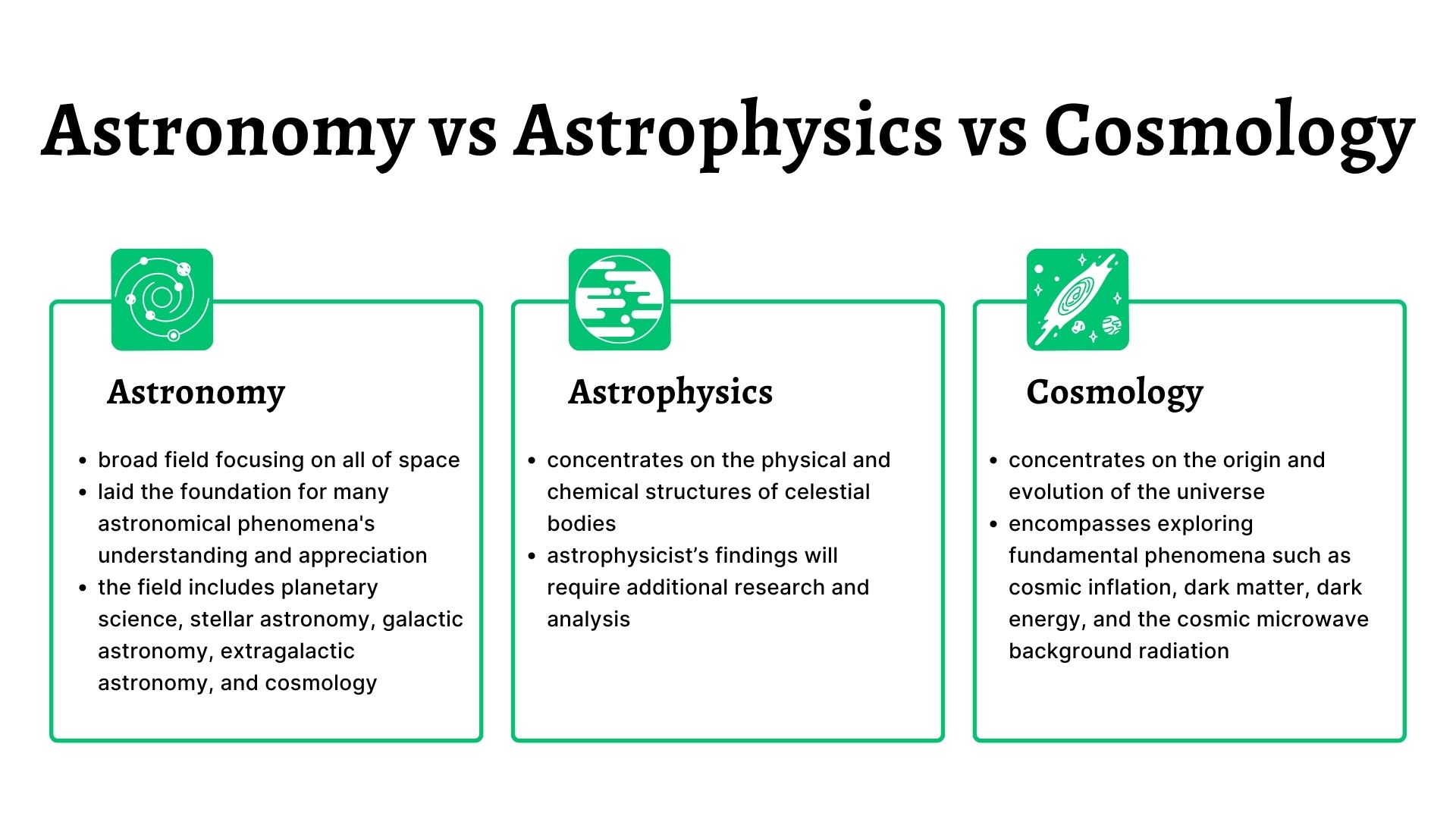
The discussion of astronomy vs. astrophysics is interesting to many, as it entails two different concepts. First, there is astronomy, the study of celestial objects and the physical universe. On the other hand, we have astrophysics, a branch of astronomy that employs principles of physics and chemistry to elucidate the birth, life, and death of stars, planets, galaxies, nebulae, and other objects in the universe. While they may sound similar, their focus varies considerably.
- What Is Astronomy?
- What Is Astrophysics?
- What Is Cosmology?
- What's the Difference Between Astronomy, Astrophysics, and Cosmology?
- FAQ
- How far is it from Earth to Mars?
- Should I major in astrophysics or astronomy?
- What universities train astronomers and astrophysicists?
- Are there amateur astrophysicists?
- Are astronomers, astrophysicists, and cosmologists still looking into different concepts?
- Is there a demand for one of these scientists over another?
What Is Astronomy?
Astronomy is a scientific study of the universe, including items beyond the Earth's atmosphere. Scientists will study many celestial objects in astronomic studies, such as the sun, moons, comets, and asteroids. The study is about exploring the universe and understanding what is outside our planet.
The observations an astronomer can conduct are vital to helping understand what is outside the Earth's atmosphere. The field is open to many people, including amateurs who have helped identify various objects and other interesting events, including the formation of stars.
Astronomy is a more generalized aspect of reviewing space. A vital part of the astronomer vs. astrophysicist debate involves how specific these two can be when reviewing items. Astronomy is a broad field focusing on all of space, while astrophysics is about the physics of space.
As a branch of science that has existed since ancient times, astronomy has laid the foundation for many astronomical phenomena's understanding and appreciation. Early humans began observing the night sky, tracking the motion of celestial bodies to predict seasons or navigational patterns. This practice evolved into the establishment of astronomy as a scientific discipline. Modern astronomy has significantly expanded, thanks to advancements in technology, such as telescopes, satellites, and space probes, which have brought the distant cosmos within our reach.
The field of astronomy is divided into multiple sub-disciplines, each focusing on different aspects of the cosmos. These include planetary science, stellar astronomy, galactic astronomy, extragalactic astronomy, and cosmology. Each of these branches contributes to a holistic understanding of the universe. It's crucial to remember that while astronomy involves observing and cataloging the universe, it also seeks to answer fundamental questions about the nature of celestial bodies and phenomena. This is where the boundary between astronomy and astrophysics starts to blur, as understanding these phenomena often requires applying the principles of physics, leading us into the realm of astrophysics.
What Is Astrophysics?
Astrophysics is a segment of astronomy that concentrates on the physical and chemical structures of celestial bodies. Scientists in astrophysics will study the properties of items and determine the nature of all these features.
A major part of the astrophysics vs. astronomy comparison involves how people in these two segments review different concepts. Whereas an astronomer will study the positions and movements of celestial items, an astrophysicist will focus on the physical features of those items. Part of the study includes reviewing how stars are born and how they die, the formation of black holes, and the chemical components of different items.
Astrophysics is more theoretical than astronomy. An astrophysicist can take the findings an astronomer records and utilize advanced mathematics and other scientific studies to develop the initial reports further. The reviews the professional uses will help identify multiple concepts surrounding how various bodies form and how they continue to evolve.
An astrophysicist and astronomer can both work together on many projects at universities and other facilities. The astronomer will identify items, and the astrophysicist will engage in further study of those items and their positions. The work is about checking on more things surrounding these celestial objects. Celestial mechanics can be incorporated into astrophysics. Celestial mechanics involves the study of how celestial bodies move. The laws of gravitation are frequent in this study.
Since much of astrophysics is theoretical, it makes the findings an astrophysicist discovers open to interpretation. This part of the astrophysicist vs. astronomer comparison is essential, as an astronomer's findings will be more definite and easier to quantify. An astrophysicist's findings will require additional research and analysis, and it's possible the results and theories one finds won't be complete.
What Is Cosmology?
Cosmology is a study of physics that entails combining astronomy and physics to understand the physical universe. Cosmologists concentrate on the origin and evolution of the universe.
An example of cosmology entails how the Hubble telescope helped create measurements of how the universe was expanding. While the Hubble found various images critical to astronomy and astrophysics, the Hubble also helped review measurements on how stars form, their pulsations, and how these stars are shifting. These points have assisted professionals in reviewing how the universe continues to grow.
Cosmologists often look into many concepts in their research. Some of these ideas include looking at what happened before the Big Bang, understanding where the Big Bang may have occurred, and the general boundaries or limitations of the universe.
Cosmology delves into the profound and often mystifying questions about the universe's structure, origins, and eventual fate. It is unique in its capacity to incorporate various physics theories, including quantum mechanics, general relativity, and thermodynamics, to make sense of everything from the smallest particles to the universe's vast expanses. As cosmologists piece together the jigsaw puzzle of our cosmos, they are constantly challenging and reshaping our comprehension of reality.
Their work encompasses exploring fundamental phenomena such as cosmic inflation, dark matter, dark energy, and the cosmic microwave background radiation. These explorations have given rise to groundbreaking models and theories, such as the Multiverse theory and the concept of a cyclic universe. It is through the lens of cosmology that we strive to decode the universe's most profound secrets, forming an intricate tapestry of understanding woven from the threads of astronomy, physics, and philosophy.
What's the Difference Between Astronomy, Astrophysics, and Cosmology?
The difference between astronomy and astrophysics is that astronomy focuses on studying items outside the Earth's atmosphere, while astrophysics concentrates on the physical structures of these beings. Cosmology can be further added to this comparison, as cosmology is a branch of astronomy that looks more into the creation and development of the universe.
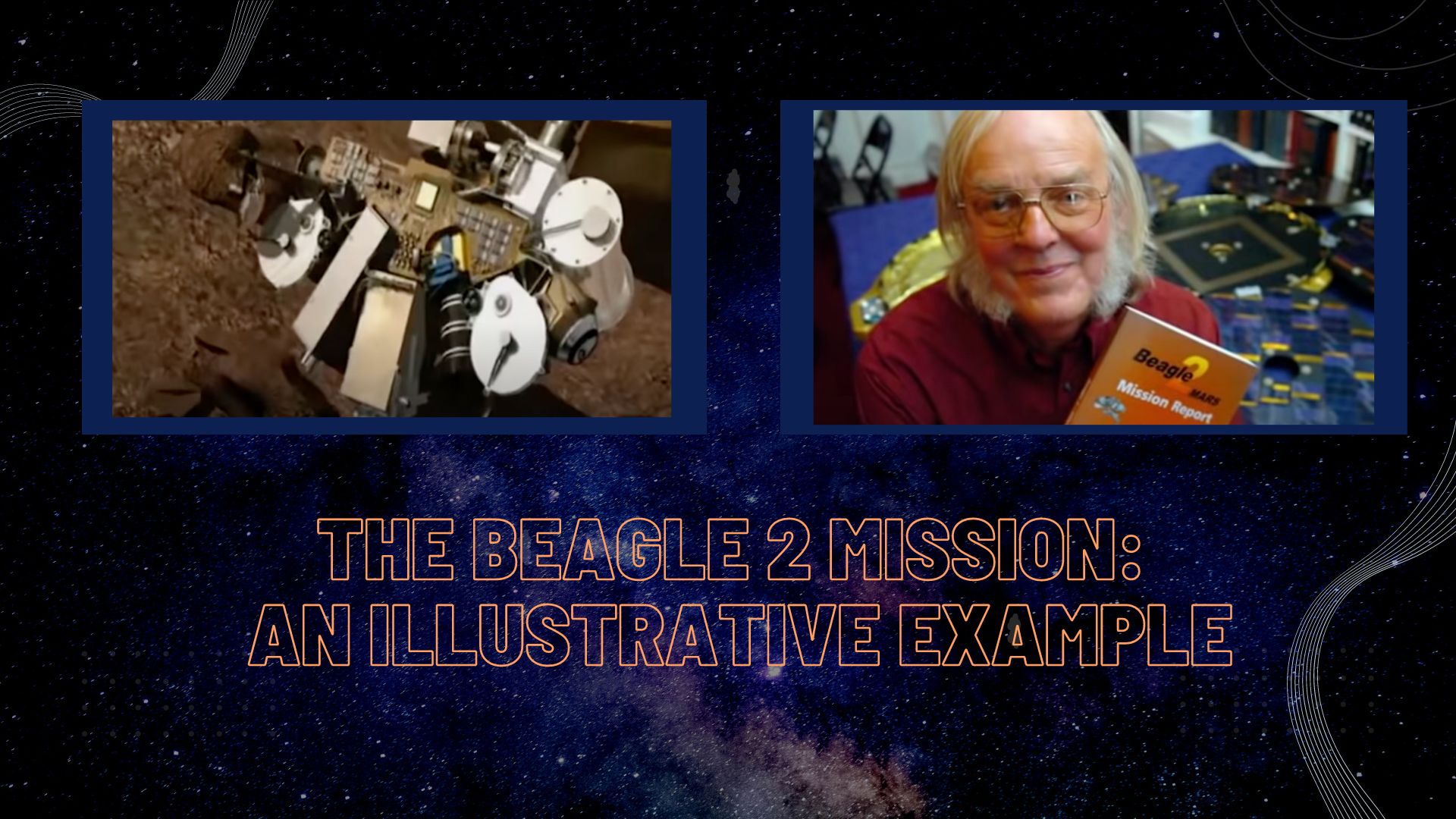
Reviewing the history of Beagle 2, a Mars lander that focused on the investigation of possible life on Mars, is a good method to grasp what is the difference between astronomy and astrophysics.
The Beagle 2 Mission: An Illustrative Example
The Beagle 2 mission serves as a good example to illustrate the roles of astronomers and astrophysicists. Launched in 2003, the Beagle 2 was a British Mars lander that was intended to study the Martian surface and atmosphere, searching for signs of life and understanding the planet's geology and climate.
In this mission:
Astronomers played a pivotal role in determining the correct windows for launch and arrival, ensuring the spacecraft reached its intended landing site on Mars, and interpreting large-scale observations made by the spacecraft, such as mapping Martian surface features.
Astrophysicists, on the other hand, were deeply involved in analyzing the physical processes on Mars. This includes understanding the Martian atmosphere, its interaction with solar radiation, the physical and chemical properties of Martian soil, and any potential interactions that might hint at life.
From the Beagle 2 mission, one might argue that both astronomers and astrophysicists played critical roles, but their focuses differed. The astronomers were more concerned with the "where" and "when", while the astrophysicists delved into the "how" and "why".
Differences Between an Astrophysicist and an Astronomer
Scope:
Astronomers generally study celestial bodies like stars, galaxies, planets, and the overall structure of the universe. They observe patterns, movements, and properties of these bodies.
Astrophysicists study the physical properties and processes of celestial objects and phenomena. They seek to understand the underlying physics that governs the universe, such as the mechanics of star formation or the interaction of black holes with surrounding matter.
Tools:
Astronomers tend to rely more on telescopes and observational data, aiming to catalog and understand the motion and behavior of celestial bodies.
Astrophysicists use a combination of observational data and theoretical models. They often employ simulations and advanced computations to understand complex physical interactions in the universe.
Research Questions:
Astronomers might ask questions like, "What is the motion of this newly discovered planet?" or "How do galaxies cluster on large scales?"
Astrophysicists might pose questions such as, "What processes power the radiation from this active galactic nucleus?" or "How do strong magnetic fields affect the behavior of neutron stars?"
Similarities Between an Astrophysicist and an Astronomer
- Foundational Knowledge: Both fields are rooted in physics and mathematics. Regardless of their specialization, professionals in both disciplines require a strong grasp of these subjects.
- Research Goals: Both astronomers and astrophysicists aim to unravel the mysteries of the universe. Whether it's understanding the lifecycle of a star or the dynamics of galaxy clusters, their ultimate objective is to gain a deeper knowledge of the cosmos.
- Collaboration: Given the overlapping nature of their work, astronomers and astrophysicists frequently collaborate on research projects and missions. Their combined expertise provides a comprehensive approach to answering big questions about the universe.
While astronomy and astrophysics are closely related fields with many overlaps, they have distinct focuses. However, the boundaries are often fluid, and many professionals identify with both titles, depending on the context of their work.
Beagle 2's Legacy: Illuminating the Significance of Mars Exploration in Astronomy, Astrophysics, and Cosmology
While the Beagle 2 never found signs of life on Mars, the lander did make some valuable discoveries surrounding Mars. From an astrophysical perspective, the Beagle 2 collected measurements of the geology and atmosphere of Mars, including understanding how surface water may have formed and how it might have been absorbed by the planet's surface.
In terms of astronomy, the images the Beagle 2 captured helped illustrate some of the challenges that could make it tough for people to reach Mars. The images showed how Mars has various craters and canyons of different sizes. The design shows that while it is possible for life to persist, it would be doing so in a challenging space.
The Beagle 2 wasn’t intended to be a cosmological device, but cosmologists have conducted various studies on how Mars could have been formed. Cosmologists believe that Mars was established after gas and dust were pulled together through gravity to form this body. The collisions of gas and dust caused energy that produced immense heat, causing the interior to melt and create a mantle and core similar to Earth. This practice is similar to how other planets form.
Astronomy, astrophysics, and cosmology are all different subjects, but they still relate to one another in many ways.
Tips for Choosing Between a Career as an Astrophysicist and an Astronomer
If you're captivated by the cosmos and considering a career exploring the universe, you might be torn between becoming an astrophysicist and an astronomer. While the differences might seem nuanced, your preference in research style, academic inclinations, and long-term goals can help you make a decision. Here are some tips to guide your choice:
Assess Your Interests:
If you're more intrigued by understanding the why and how behind celestial phenomena — for instance, why stars explode or how black holes work — astrophysics might be more your speed.
If you're passionate about observing, cataloging, and understanding the vast structures and movements in the universe, a career in astronomy would probably suit you best.
Consider Your Academic Strengths:
Astrophysics often demands a deeper dive into theoretical physics, so if you have a strong affinity for rigorous physical theories and mathematical modeling, this might be the route for you.
Astronomy, while still requiring a good grasp of physics and mathematics, often emphasizes observational techniques and data analysis. If you enjoy working with advanced instruments and have a keen eye for details in data, astronomy might be your calling.
Think About Your Preferred Work Environment:
Astrophysicists often work with computer simulations and theoretical models, meaning you might spend more time in front of a computer or in a lab setting.
Astronomers tend to work more with telescopes, which could involve traveling to remote observatories around the world and possibly working during nighttime hours when observations are made.
Research Opportunities:
Before deciding, consider reaching out to professionals in both fields or securing internships. This will give you a firsthand glimpse of the day-to-day activities in each profession and could make your decision clearer.
Universities often have both astronomy and astrophysics departments. Enrolling in introductory courses in both subjects can provide insight into which resonates more with you.
Long-Term Goals:
If you're keen on developing new theories about the universe's underlying mechanics, or dream of solving some of the core mysteries of the cosmos using the laws of physics, astrophysics might be the right path.
If you see yourself discovering new celestial bodies, charting unexplored regions of space, or using telescopes to uncover the secrets of the universe's vast structures, then a career in astronomy could be your destiny.
Interdisciplinary Appeal:
Remember, the boundaries between astronomy and astrophysics are often fluid. Many professionals in the field find themselves straddling both disciplines. Your career might evolve over time, allowing you to wear both hats, so choose a path that feels right for now, knowing you can always pivot later.
Whether you opt for a career in astronomy or astrophysics, you'll be contributing to humanity's understanding of the vast, mysterious universe that surrounds us. Both fields offer exciting challenges and the thrill of discovery, so follow your passion and let the stars be your guide.
FAQ
How far is it from Earth to Mars?
Mars is approximately 214 million miles from Earth. It is much further than Venus, which is about 37 million miles from Earth. Meanwhile, the Moon is around 238,900 miles from Earth on average.
Should I major in astrophysics or astronomy?
The answer depends on your interests. Astronomy is better for people interested in observational science, while astrophysics is more about the physics of space. When deciding on a master's degree major, make sure that you know what is the difference between astronomer and astrophysicist.
What universities train astronomers and astrophysicists?
There are various universities in the world that train astronomers and astrophysicists. Many of these schools include ones that focus heavily on the sciences, like the Massachusetts Institute of Technology and Stanford University.
Are there amateur astrophysicists?
There aren’t many amateur astrophysicists, as the difference between an astronomer and an astrophysicist entails how astrophysicists focus more on advanced mathematics and measurements. Because the subject they learn emphasises on observation, amateur astronomers are more common.
Are astronomers, astrophysicists, and cosmologists still looking into different concepts?
Many students in these fields continue studying concepts like whether the universe is infinite, whether parallel universes exist, and how the universe could potentially end. There are many concepts in all three fields that continue to grow, and the desire to keep reviewing each subject will be vast.
Is there a demand for one of these scientists over another?
One difference between an astrophysicist and an astronomer is that astrophysicists are often in higher demand due to the more intensive nature of their studies. While astronomers can work with more advanced telescopes and analyses, astrophysicists look into more detailed measurements and data concepts.


